
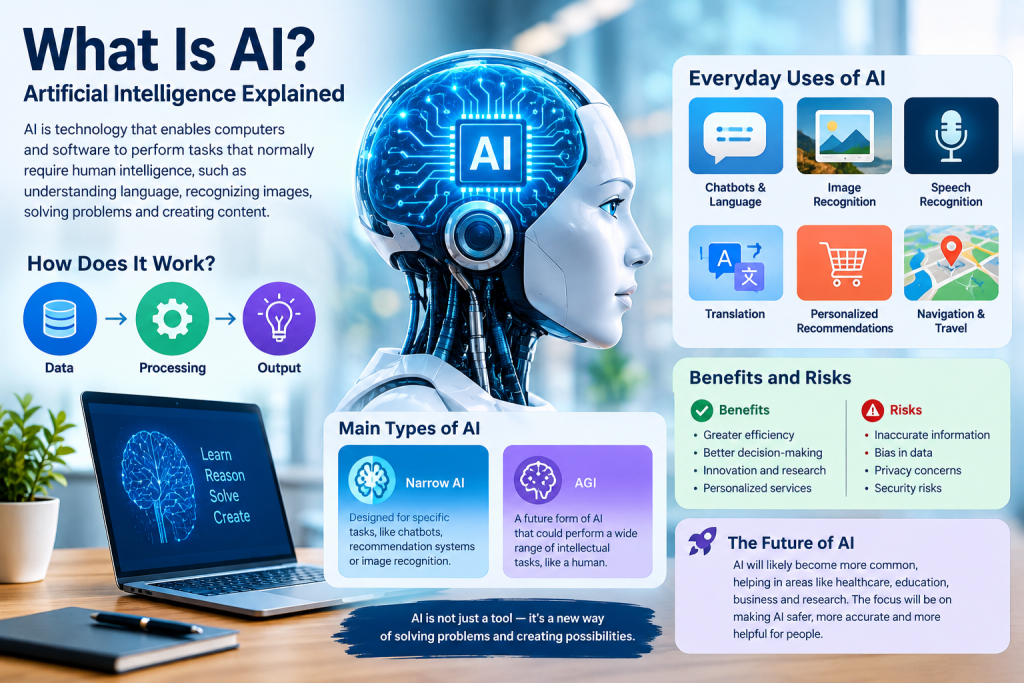
Artificial intelligence (AI) is technology that enables computers and software to perform tasks that normally require human intelligence, such as understanding language, recognizing images, finding patterns, solving problems, and generating content. AI systems learn from data or follow programmed rules to produce useful results. Today, AI is used in search engines, smartphones, healthcare, education, finance, customer service, transportation, and creative tools.
What Is AI and How Does It Work?
AI works by using computer systems to process information, identify patterns, and produce an output based on instructions, data, or learned relationships.
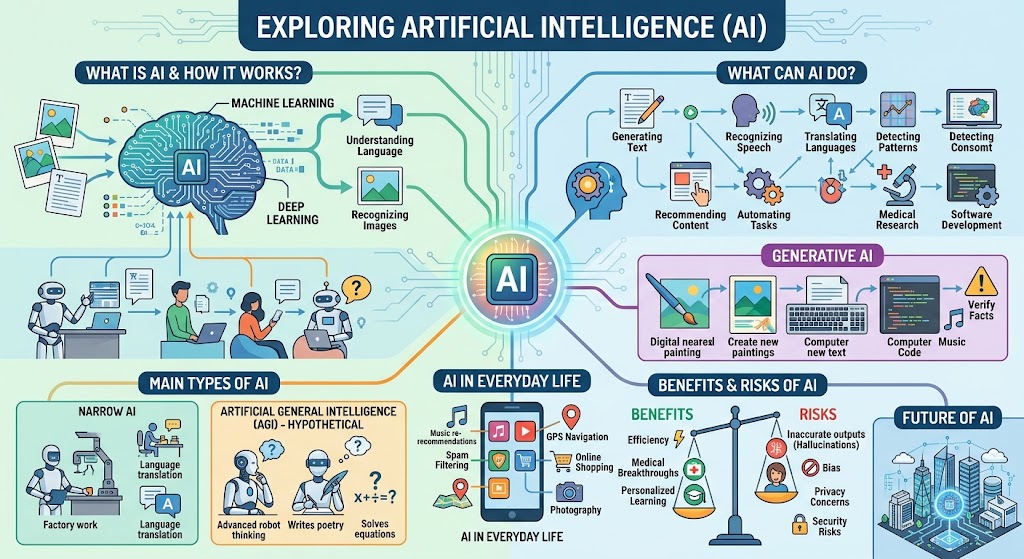
A major area of AI is machine learning, where a system learns patterns from examples rather than being explicitly programmed for every individual situation. For example, a machine-learning model can examine many labeled photographs and learn to distinguish between different objects.
Modern AI also includes deep learning, which uses layered mathematical models called neural networks. These systems can process large amounts of information and are widely used for language recognition, image analysis, recommendation systems, and generative AI.
What Can Artificial Intelligence Do?
AI can perform a wide range of tasks depending on how the system is designed and trained.
Common applications include:
- Understanding and generating text
- Recognizing speech
- Translating languages
- Identifying objects in images
- Detecting patterns in large datasets
- Recommending products, videos, or music
- Automating repetitive tasks
- Assisting with software development
- Generating images, audio, and video
- Supporting scientific and medical research
AI does not perform all these tasks in the same way. A system designed to recognize faces, for example, has a very different purpose from a chatbot designed to generate text.
What Is Generative AI?
Generative AI is a type of artificial intelligence that creates new content based on patterns learned from existing data.
Generative AI can produce text, images, computer code, audio, and other forms of content. Chatbots and image-generation systems are common examples. Instead of simply retrieving an existing answer, a generative model can construct a new response based on the information and patterns available to it.
However, generated content is not automatically correct. AI systems can produce inaccurate information, misunderstand questions, or present uncertain information confidently, so important facts should be independently checked.
How Is AI Used in Everyday Life?
AI already operates behind many everyday digital services, often without users noticing it.
For example, streaming platforms may use algorithms to recommend movies or music based on viewing and listening patterns. Email services can use AI to detect spam, while smartphones can use AI for speech recognition, photography improvements, translation, and predictive text.
Online shopping platforms may also analyze browsing and purchasing behavior to personalize recommendations. Navigation applications can use algorithms and real-time information to estimate travel times and suggest routes.
What Are the Main Types of AI?
AI can be described in different ways, but one useful distinction is between narrow AI and hypothetical forms of broader intelligence.
Narrow AI
Narrow AI is designed to perform specific tasks or a limited range of tasks. Most AI systems people use today fall into this category.
A language model, recommendation engine, fraud-detection system, or image-recognition model may be highly capable within its intended function without possessing general human intelligence.
Artificial General Intelligence
Artificial general intelligence, often called AGI, refers to a hypothetical AI system capable of performing a broad range of intellectual tasks at a level comparable to or beyond humans.
AGI is different from the specialized AI systems commonly available today. The term is used in research and discussion about the future of artificial intelligence, but there is no universally accepted test that establishes a system as AGI.
What Are the Benefits of AI?
AI can help people analyze information, automate repetitive work, identify patterns, and complete certain tasks more efficiently.
In healthcare, AI can assist with analyzing medical images and research data. In education, it can support personalized learning and provide explanations or practice exercises. In business, AI can help with data analysis, customer support, forecasting, and document processing.
The value of AI depends heavily on how it is designed and used. Human oversight remains important, particularly when AI output affects health, finances, employment, legal matters, or other high-impact decisions.
What Are the Risks and Limitations of AI?
AI has important limitations, including inaccurate outputs, biased results, privacy concerns, security risks, and excessive dependence on automated systems.
An AI model may produce an answer that sounds convincing but is factually incorrect. This is sometimes called a hallucination, meaning the system generates unsupported or false information.
AI systems can also reflect limitations or biases present in their training data. For this reason, responsible AI use involves testing systems, protecting sensitive information, checking important outputs, and maintaining appropriate human oversight.
What Is the Future of AI?
The future of AI is likely to involve increasingly widespread use across research, business, education, software, healthcare, and everyday digital services.
The exact capabilities and impact of future AI systems remain uncertain. Researchers and organizations continue to work on improving accuracy, safety, reliability, transparency, and the ability of AI systems to work effectively with people.
As AI becomes more common, understanding both its capabilities and limitations will become increasingly useful for making informed decisions about when and how to use it.
Conclusion
AI is a broad field of technology that enables computers to perform tasks involving patterns, language, perception, prediction, and content generation. What is AI ultimately comes down to using computational systems to perform tasks associated with human intelligence, although current systems have significant limitations. Readers interested in the subject may also explore machine learning, generative AI, and the differences between AI and AGI.