
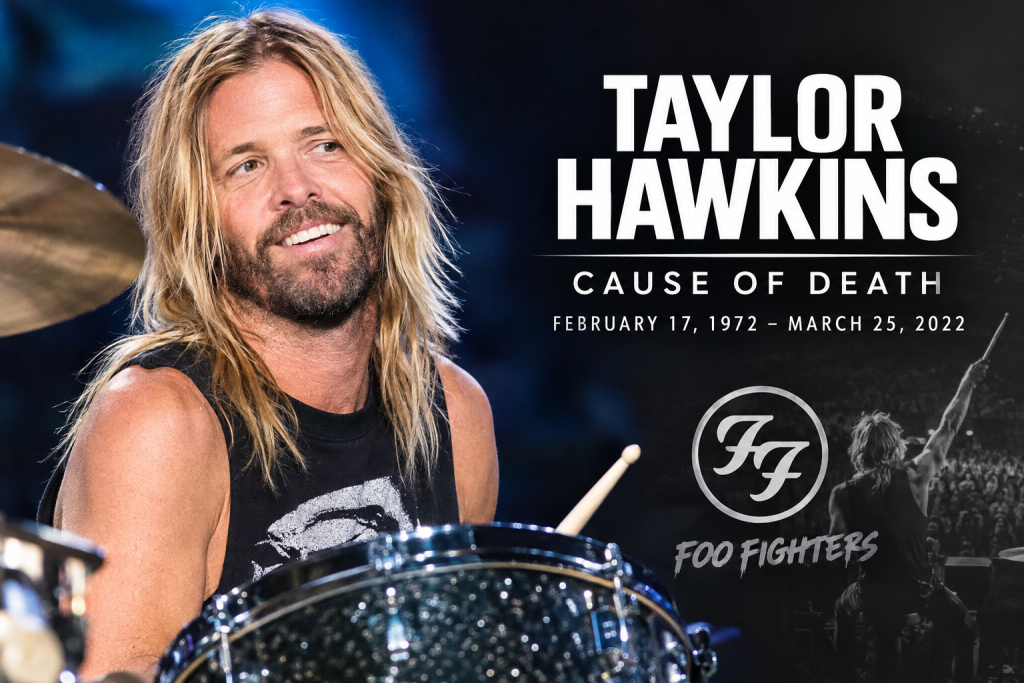
Taylor Hawkins, the longtime Foo Fighters drummer, died suddenly on March 25, 2022, at age 50, in Bogotá, Colombia. Taylor Hawkins’ cause of death was never publicly established through a definitive official medical ruling. Colombian authorities reported that he had complained of chest pain and that preliminary toxicology testing detected 10 substances, including opioids, benzodiazepines, antidepressants, and THC. However, the toxicology findings did not by themselves establish exactly what caused his death.
What Happened to Taylor Hawkins?
Taylor Hawkins died in a hotel in Bogotá shortly before the Foo Fighters were scheduled to perform at the Estéreo Picnic festival. Emergency services received a call concerning a patient experiencing chest pain and attempted resuscitation after finding Hawkins unresponsive, but he could not be revived.
Hawkins had been in Colombia as part of the Foo Fighters’ South American tour. His unexpected death was announced by the band on March 25, 2022, prompting tributes from musicians and fans around the world.

Did Drugs Cause Taylor Hawkins’ Death?
The available public evidence does not establish that a drug overdose was definitively the cause of Taylor Hawkins’ death. A preliminary urine toxicology test conducted by Colombian authorities detected 10 different substances, including THC, tricyclic antidepressants, benzodiazepines, and opioids.
Why the Toxicology Report Matters
Finding drugs or medications in someone’s system does not automatically mean those substances caused the person’s death. Determining cause of death generally requires consideration of toxicology, autopsy findings, medical history, and other forensic evidence.
At the time of the initial report, Colombia’s National Institute of Forensic Medicine said it was continuing medical studies to clarify the circumstances surrounding Hawkins’ death.
Was Taylor Hawkins’ Death an Overdose?
An overdose was discussed in some early media reports, but it should not be presented as an officially confirmed cause of death. UPI reported at the time that Colombian officials indicated a possible drug overdose while emphasizing that the official cause had not yet been determined.
This distinction is important because the preliminary toxicology results showed the presence of multiple substances but did not, by themselves, demonstrate that an overdose caused the fatal event.
Did Taylor Hawkins Have Heart Problems?
Chest pain was reported shortly before Hawkins died, which raised questions about a possible cardiovascular event. Some media reports also discussed findings concerning the size of his heart, but these reports should not be treated as a definitive official explanation for his death.
The publicly available reporting therefore supports describing the circumstances as a sudden death following reported chest pain, with multiple substances detected in his system, rather than assigning a single confirmed medical cause.
How Old Was Taylor Hawkins When He Died?
Taylor Hawkins was 50 years old when he died on March 25, 2022. He was born on February 17, 1972, and had been a member of the Foo Fighters since 1997.
He became one of the band’s most recognizable members and played drums on numerous Foo Fighters recordings and performances. His death occurred during the band’s South American tour.
What Was Taylor Hawkins’ History With Drugs?
Hawkins had previously spoken publicly about his history of substance use. In an interview reported by the Los Angeles Times, he discussed a heroin overdose in 2001 that left him in a coma and described that period as a time when his drug use had become dangerous.
However, his past history should not be used to conclude what caused his death in 2022. The circumstances of his final illness and death require separate consideration from events many years earlier.
Why Is Taylor Hawkins’ Cause of Death Still Discussed?
Taylor Hawkins’ cause of death continues to receive attention because the initial forensic information revealed multiple substances while authorities did not publicly establish a definitive cause in the reporting that followed. This created a distinction between what was known—his sudden death, reported chest pain, and toxicology findings—and speculation about why he died.
For that reason, claims that simply state “Taylor Hawkins died from an overdose” are stronger than the publicly documented evidence supports. A more accurate description is that he died suddenly in Bogotá, while preliminary toxicology showed multiple substances in his system, but a definitive publicly confirmed cause was not established.
Taylor Hawkins’ Legacy With Foo Fighters
Taylor Hawkins joined Foo Fighters in 1997 and remained the band’s drummer for more than two decades. His energetic playing and stage presence became an important part of the group’s live identity.
Following his death, Foo Fighters organized major tribute concerts celebrating his life and music. The band later released But Here We Are, its first album following Hawkins’ death, as a reflection of the losses experienced by the group.
Conclusion: Taylor Hawkins Cause of Death
The most accurate answer regarding Taylor Hawkins’ cause of death is that no definitive publicly confirmed medical cause should be stated as fact based on the available reporting. He died suddenly in Bogotá on March 25, 2022, after reported chest pain, and preliminary toxicology detected 10 substances, including opioids, benzodiazepines, antidepressants, and THC.
The most accurate answer regarding Taylor Hawkins’ cause of death is that no definitive publicly confirmed medical cause should be stated as fact based on the available reporting. He died suddenly in Bogotá on March 25, 2022, after reported chest pain, and preliminary toxicology detected 10 substances, including opioids, benzodiazepines, antidepressants, and THC.
Readers interested in the subject can also explore Taylor Hawkins’ Foo Fighters career, his history as a drummer, and the tribute concerts held in his memory.