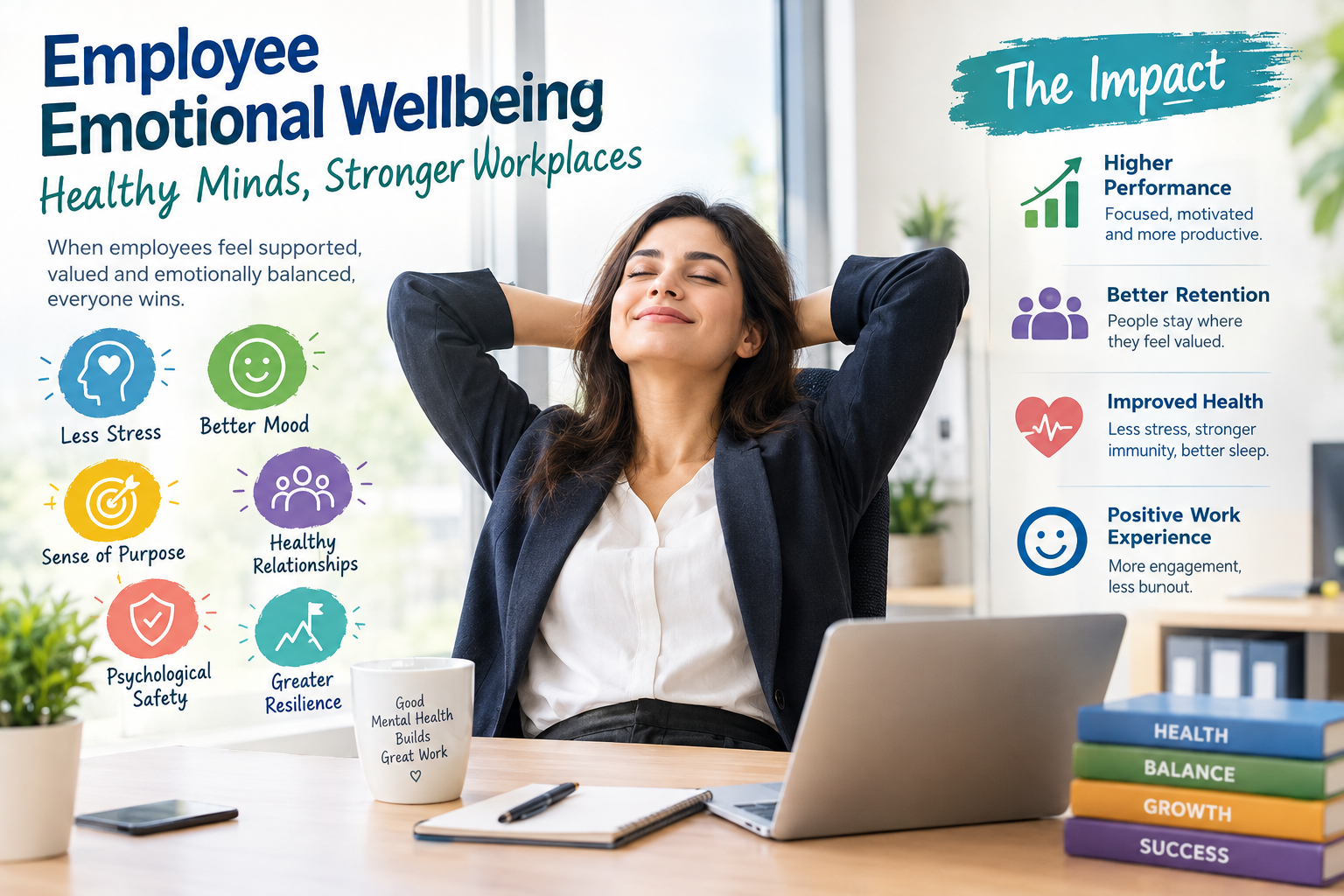
Employee emotional wellbeing is the degree to which people feel mentally steady, valued, and able to cope with the demands of their work. It covers stress levels, mood, sense of purpose, and relationships with colleagues and managers. Emotional wellbeing is a part of overall employee wellbeing, alongside physical, financial, and social health, and it strongly shapes performance, retention, and daily experience at work.
Employee emotional wellbeing is the degree to which people feel mentally steady, valued, and able to cope with the demands of their work. It covers stress levels, mood, sense of purpose, and relationships with colleagues and managers. Emotional wellbeing is a part of overall employee wellbeing, alongside physical, financial, and social health, and it strongly shapes performance, retention, and daily experience at work.
Employee emotional wellbeing is the degree to which people feel mentally steady, valued, and able to cope with the demands of their work. It covers stress levels, mood, sense of purpose, and relationships with colleagues and managers. Emotional wellbeing is a part of overall employee wellbeing, alongside physical, financial, and social health, and it strongly shapes performance, retention, and daily experience at work.
What Does Emotional Wellbeing at Work Mean?
Emotional wellbeing at work means an employee can manage stress, express concerns safely, and feel a sense of belonging and competence in their role. It does not mean constant happiness. A person with strong emotional wellbeing still experiences frustration, disappointment, and pressure, but has the resources and support to handle them without lasting harm.
Researchers often describe it through a few connected elements: emotional regulation (managing reactions to difficult situations), psychological safety (feeling able to speak up without fear of punishment), resilience (recovering from setbacks), and job satisfaction. Related terms include mental wellbeing, psychological wellbeing, and workplace mental health. These overlap heavily, though “mental health” more often refers to clinical conditions such as depression or anxiety, while “emotional wellbeing” describes the broader, everyday state.

How Is It Different From Mental Health?
Emotional wellbeing describes how a person feels and copes day to day, while mental health conditions are diagnosable disorders. Someone without any diagnosis can have poor emotional wellbeing during a stressful period, and someone with a managed condition can have good emotional wellbeing. Treating the two as identical leads employers either to ignore milder struggles or to treat all distress as a medical problem.
Why Does Employee Emotional Wellbeing Matter?
Emotional wellbeing matters because it directly affects health, productivity, and whether people stay in their jobs. The World Health Organization estimates that depression and anxiety cause about 12 billion lost working days each year worldwide, at a cost of nearly US$1 trillion annually in lost productivity. These figures show that emotional strain is a measurable economic issue, not only a personal one.
Effects on Performance and Retention
Employees under sustained emotional strain tend to make more errors, concentrate less well, and miss more work. Two patterns are commonly distinguished. Absenteeism means being away from work, while presenteeism means being at work but functioning below normal capacity, and studies frequently find presenteeism costs employers more than absence does. Poor wellbeing is also a frequent factor in resignations, and replacing an employee commonly costs a meaningful fraction of that person’s annual salary.
Effects on Health and Relationships
Chronic work stress is linked to sleep problems, cardiovascular risk, and weakened immunity. It also affects life outside work, since irritability and exhaustion carry into family and social relationships. This is why emotional wellbeing is considered a health topic and not only a workplace perk.
What Causes Poor Emotional Wellbeing at Work?
Poor emotional wellbeing at work is usually caused by the conditions of the job rather than by individual weakness. The WHO and the International Labour Organization recognize several psychosocial risk factors, meaning features of work design and management that can harm mental health.
- Excessive workload or unrealistic deadlines
- Low control over how or when work is done
- Unclear roles or frequent changes without explanation
- Bullying, harassment, or discrimination
- Poor management and lack of recognition
- Job insecurity
- Poor boundaries between work and personal life, including constant availability after hours
What Is Burnout?
Burnout is a state of exhaustion, growing cynicism toward work, and reduced effectiveness caused by chronic workplace stress that has not been successfully managed. The WHO classifies it as an occupational phenomenon in the ICD-11, not as a medical condition. It develops gradually, so early signs such as constant tiredness and detachment are easy to dismiss.
What Are the Signs an Employee Is Struggling?
Signs of poor emotional wellbeing include changes in behavior, mood, and work patterns that persist over weeks rather than days. No single sign is proof of a problem, and many people hide their difficulties.
Common indicators include withdrawing from colleagues, increased irritability, declining quality of work, frequent lateness or absence, difficulty concentrating, and visible exhaustion. Managers should respond to changes from a person’s normal pattern, and they should not try to diagnose. A calm, private conversation that asks how the person is doing is more useful than speculation.
How Can Employers Support Emotional Wellbeing?
Employers support emotional wellbeing most effectively by fixing the working conditions that cause strain, then adding individual support. The WHO’s 2022 guidelines on mental health at work make this order of priority explicit: organizational changes come first, such as manageable workloads and clear expectations.
Organizational Measures
- Assess workload and staffing regularly, and adjust when demands exceed capacity.
- Give employees reasonable control over scheduling and methods where the job allows.
- Train managers to hold supportive conversations and recognize warning signs.
- Set and enforce clear policies against bullying and harassment.
- Encourage genuine time off and discourage routine after-hours messaging.
Individual Support
Employee assistance programs (EAPs) offer confidential counseling, usually at no cost to the employee. Other options include mental health days, flexible or remote arrangements, and health insurance that covers therapy. These supports work best alongside, not in place of, healthier working conditions.
What Can Employees Do for Their Own Emotional Wellbeing?
Employees can protect their emotional wellbeing by setting boundaries, building support networks, and seeking help early. These steps help but cannot fully offset a harmful work environment.
Practical habits include taking regular breaks, keeping a consistent sleep schedule, separating work from personal time, and talking to a trusted colleague, friend, or professional when stress builds. If symptoms such as persistent low mood, panic, or hopelessness last more than a couple of weeks, speaking with a doctor or mental health professional is appropriate. Anyone in crisis should contact local emergency services or a crisis line.
Common Misconceptions About Employee Emotional Wellbeing
Several widely held beliefs about workplace wellbeing are inaccurate and can lead to poor decisions.
Misconception: Wellbeing programs alone solve the problem. Yoga classes or meditation apps do not address excessive workload or poor management. Research consistently shows that programs aimed only at individuals have limited effect when the underlying causes remain.
Misconception: Happy employees are always productive employees. The relationship is real but modest. Wellbeing supports performance, yet it is not a guarantee, and treating happiness as a productivity tool can feel manipulative to staff.
Misconception: Talking about emotions at work is unprofessional. Psychological safety, the ability to raise concerns openly, is consistently linked with better teamwork and fewer unreported problems.
How Is Employee Emotional Wellbeing Measured?
Employee emotional wellbeing is measured through a mix of surveys, behavioral data, and conversations. Anonymous engagement or pulse surveys ask about stress, support, and workload. Absence rates, turnover, and use of EAP services provide indirect signals, though low usage does not necessarily mean low need, because stigma keeps many people from seeking help.
Validated tools such as the WHO-5 Wellbeing Index, a five-question scale, give standardized scores that can be tracked over time. Whatever method is used, results should be confidential, and employers should act visibly on the findings, since surveys without follow-up reduce trust.
Conclusion
Employee emotional wellbeing reflects how well people cope with, and are supported in, their work. It is shaped mainly by working conditions, such as workload, control, relationships, and management, and it affects health, performance, and retention. Employers get the strongest results by addressing causes first and offering individual support second, while employees benefit from boundaries and early help-seeking. Readers who want to go further may explore workplace burnout prevention or how psychological safety works in teams.