
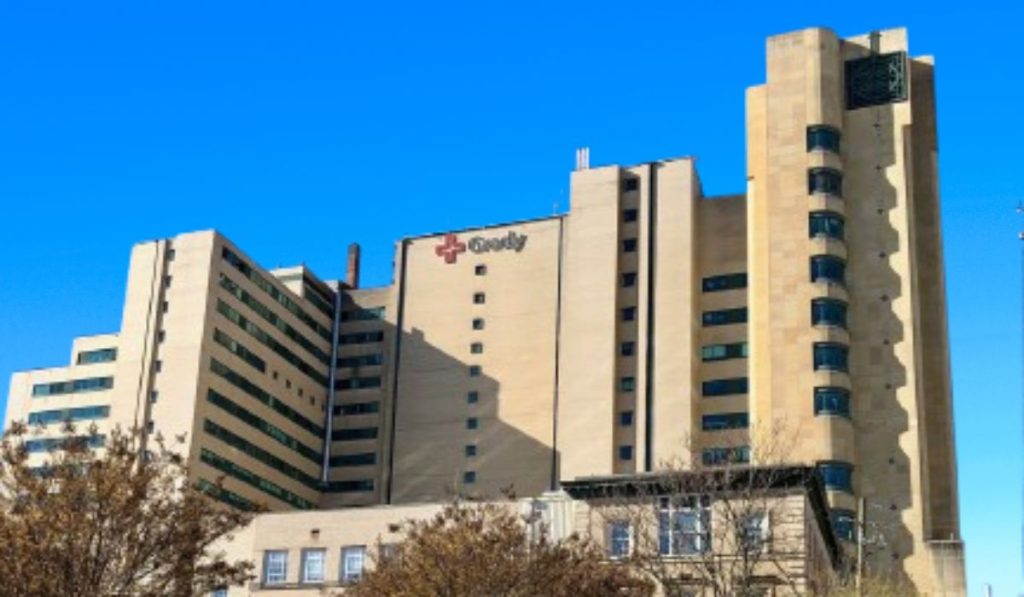
Grady Memorial Hospital is a 953-bed public teaching hospital in downtown Atlanta, Georgia, and the flagship facility of the Grady Health System. Founded in 1892, it is the largest hospital in Georgia and one of the busiest Level I trauma centers in the United States, handling more than 9,000 trauma activations a year. Grady serves as the region’s primary safety-net hospital, is affiliated with Emory University and Morehouse School of Medicine, and operates the only burn center and poison control center in the state.
Note that several other hospitals share the name “Grady Memorial,” including facilities in Chickasha, Oklahoma, and Delaware, Ohio. This article focuses on Grady Memorial Hospital in Atlanta, the one most commonly referenced in national healthcare coverage due to its size and trauma-care role.
What Is Grady Memorial Hospital?
Grady Memorial Hospital is a nonprofit, publicly supported acute care hospital located at 80 Jesse Hill Jr. Drive SE in downtown Atlanta. It operates as a voluntary non-profit private hospital with 953 beds and is affiliated with the Grady Health System. Beyond inpatient care, Grady functions as a major academic medical center, training resident physicians from Emory and Morehouse in nearly every medical specialty. It is now the fifth-largest public hospital in the country and one of the busiest Level I trauma centers in the United States.
Grady’s mission has remained consistent since its founding: providing high-quality care regardless of a patient’s ability to pay. It maintains a particular commitment to underserved residents of Fulton and DeKalb counties, while also serving patients from across metro Atlanta and the state of Georgia. This mission shapes both its patient population and its funding structure, which relies heavily on public support, Medicare and Medicaid reimbursement, and philanthropic contributions rather than purely private insurance revenue.
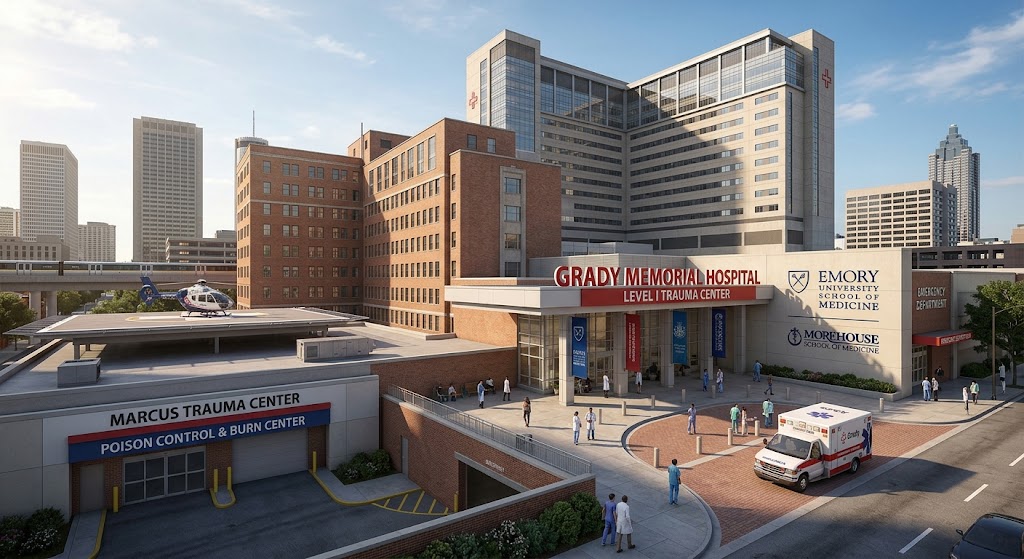
What Is the History of Grady Memorial Hospital?
Grady Memorial Hospital was established in 1892 as a 110-bed facility and named after Henry W. Grady, an Atlanta Constitution journalist and editor known for advocating a “New South” built on economic development and public institutions. Grady’s vision was to create a hospital that would provide quality healthcare to all citizens of Atlanta regardless of financial means. The hospital’s early history included segregated care, and it was informally known among older Black Atlantans as “the Gradys” because of separate facilities for Black and white patients.
Desegregation and Expansion
Segregation at Grady ended following a legal settlement, and by 1965 the hospital was officially integrated in compliance with the Civil Rights Act of 1964. This desegregation allowed Grady to begin receiving Medicare and Medicaid reimbursements, which eased financial strain and enabled the hospital to establish specialized centers for pediatrics, muscular dystrophy, nephrology, poison control, diabetes, sickle cell disease, and burn care. In the mid-twentieth century, the hospital moved to its third campus and, in 1954, broke ground on a twenty-one-story tower housing more than a thousand beds and multiple operating rooms. hekint
Modern Milestones
Grady has continued to expand its clinical footprint into the twenty-first century. The first patients were transported to Grady by horse-drawn ambulance until the hospital purchased its first motorized ambulance in 1911, an early sign of its long involvement in emergency medical transport. In more recent years, the hospital has pursued major capital projects, including a planned renovation of its women’s and infants’ center and an expansion of the Marcus Stroke and Neuroscience Center and emergency department.
What Trauma and Emergency Services Does Grady Provide?
Grady operates the only nationally verified Level I trauma center in the Atlanta metro area, making it the primary destination for the region’s most critically injured patients. Grady handles close to 3,500 acute trauma admissions each year and provides comprehensive care to critically injured patients from across Georgia, supported by ready access to surgical suites, a dedicated burn unit, and air medical transport programs. It ranks among the five busiest Level I trauma centers in the nation and is the busiest in the Southeast.
The Marcus Trauma Center
The hospital’s emergency care is anchored by the Marcus Trauma Center, a purpose-built resuscitation unit inside the emergency department. This 15-bed facility contains seven major resuscitation rooms, eight moderate-to-minor trauma rooms, a self-contained digital radiology suite and reading room, two conference rooms, and on-call rooms for staff. Because of this capacity, medical fellows, residents, and even military special forces medics travel to Atlanta specifically to train at the Marcus Trauma Center.
Emergency Department Structure
Patients arriving at Grady’s emergency department are first routed through a triage process designed to prioritize care by severity. Ambulatory and ambulance patients are evaluated separately, with a nurse and physician assistant or nurse practitioner team assessing severity and initiating lab work or diagnostic studies. A small subset of non-urgent patients can be seen and discharged directly from triage, with follow-up arranged through the hospital’s Patient Navigator Program, which helps reduce unnecessary emergency room congestion while still connecting patients to primary care.
What Specialty Centers Operate Within Grady Health System?
Grady is home to more than 60 specialty care centers, several of which hold statewide or national distinction. These include Georgia’s only burn center for adult and pediatric patients, the Advanced Comprehensive Marcus Stroke and Neuroscience Center, an award-winning heart failure program, the world’s first 24/7 sickle cell center, one of the nation’s top HIV/AIDS treatment centers, and Georgia’s only poison control center. Grady also operates one of the nation’s most advanced hospital-based 911 EMS services and Georgia’s largest mental health program.
Stroke and Neuroscience Care
The Marcus Stroke and Neurosciences Center is a designated Joint Commission Advanced Comprehensive Stroke Center, meaning it meets rigorous standards for treating the most complex stroke cases, including those requiring specialized surgical intervention. Its close integration with the emergency department allows stroke patients to move quickly from triage to advanced imaging and treatment, which is critical given how time-sensitive stroke outcomes are.
Poison Control and Burn Care
Grady’s Poison Center handles roughly 100,000 calls a year and is one of only two burn centers in the state of Georgia. These two services often intersect clinically, since chemical exposures and burn injuries frequently require coordinated toxicology and wound-care expertise, and Grady is one of the few facilities in the region equipped to manage both simultaneously.
What Academic and Health System Affiliations Does Grady Have?
Grady Memorial Hospital serves as the primary teaching hospital for two medical schools, giving it an unusually large and diverse resident physician workforce. It is affiliated with Emory University School of Medicine and Morehouse School of Medicine, providing clinicians exposure to innovative research and progressive medical education. Residents in fields ranging from orthopaedics to emergency medicine rotate through Grady during every year of training, gaining experience with a high-acuity, high-volume patient population that few other hospitals can offer.
This academic relationship also drives Grady’s research output, particularly in trauma care, sickle cell disease, and infectious disease treatment. Because residents and fellows from around the world train at Grady, the hospital maintains close ties to ongoing clinical trials and emerging therapies, which patients can sometimes access before they become widely available elsewhere.
What Are Common Misconceptions About Grady Memorial Hospital?
One common misconception is that Grady is a low-quality hospital because it primarily serves uninsured and low-income patients. In reality, Grady’s trauma, stroke, burn, and sickle cell programs are recognized as among the best in the country by clinical volume and outcomes, and its Level I trauma verification requires meeting strict national standards. Patient volume and financial need are not the same as quality of care, and Grady’s specialty centers are frequently the referral destination even for patients with private insurance.
Another misconception is that “Grady” and “Grady Health System” refer to the same single building. In practice, Grady Health System encompasses the main downtown hospital along with neighborhood health centers and outpatient clinics throughout Fulton and DeKalb counties, all operating under a shared governance and mission. A third point of confusion is the hospital’s name itself, since other unrelated hospitals named Grady Memorial exist outside Georgia; anyone searching for a specific facility should confirm the city and state before assuming they mean the Atlanta location.
How Do You Visit or Receive Care at Grady?
Grady Memorial Hospital is located at 80 Jesse Hill Jr. Drive SE, Atlanta, GA 30303, near the Georgia State University campus in downtown Atlanta. The main hospital line is (404) 616-4252, and the facility accepts a wide range of insurance, including Medicare, Medicaid, Aetna, Blue Cross Blue Shield, Cigna, and United Healthcare. Patients without insurance are still eligible for care, consistent with the hospital’s founding mission, though financial assistance programs and eligibility should be confirmed directly with Grady’s patient financial services department.
For non-emergency specialty care, patients typically need a referral or appointment through one of Grady’s outpatient clinics rather than walking directly into the main hospital. Anyone experiencing a medical emergency, including major trauma, stroke symptoms, burns, or suspected poisoning, should call 911 or go directly to the emergency department rather than attempting to schedule an outpatient visit.
Key Takeaways
Grady Memorial Hospital is Atlanta’s largest public hospital and Georgia’s busiest Level I trauma center, built on a founding mission of accessible care that has shaped its identity since 1892. Its designation as home to the state’s only burn center and poison control center, combined with deep academic ties to Emory and Morehouse, gives it a clinical reach far beyond what its safety-net reputation might suggest. Readers interested in related topics may want to explore how Level I trauma center designation works nationally, or how public safety-net hospitals are funded compared to private nonprofit systems.