
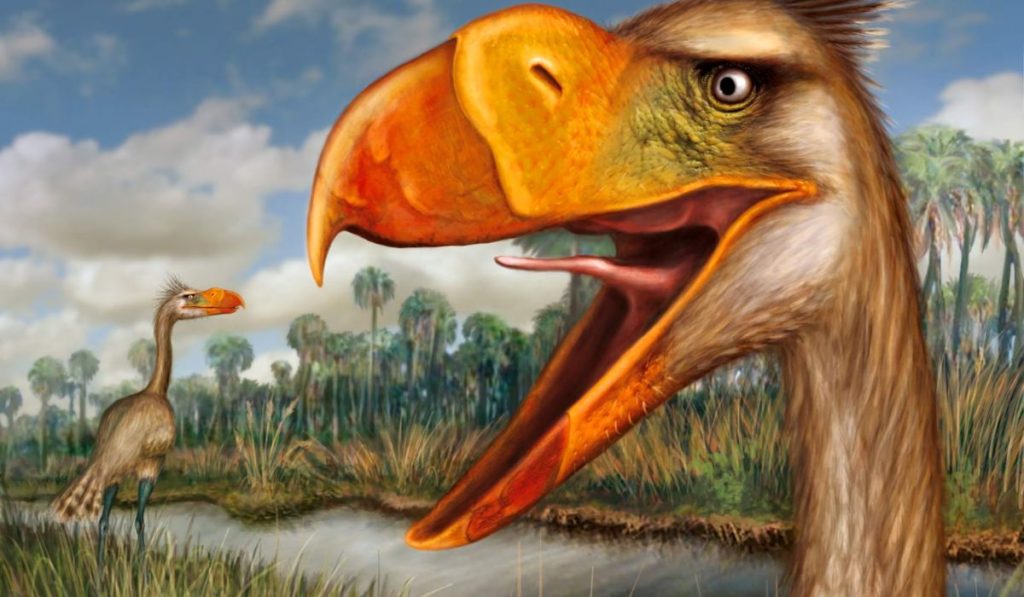
Imagine walking through a quiet forest millions of years ago. The air is thick, the ground trembles slightly, and suddenly—you hear heavy footsteps. Not from a dinosaur, but from something just as terrifying: a towering, flightless bird with a hooked beak sharp enough to crush bone. Sounds unreal, right? Yet this creature truly existed.
Welcome to the gripping story of the terror bird, one of the most formidable predators to ever walk the Earth.
What Exactly Was a Terror Bird?
The term “terror bird” refers to a group of large, flightless birds scientifically known as phorusrhacids. These birds lived millions of years ago, mostly in South America, and later spread into North America.
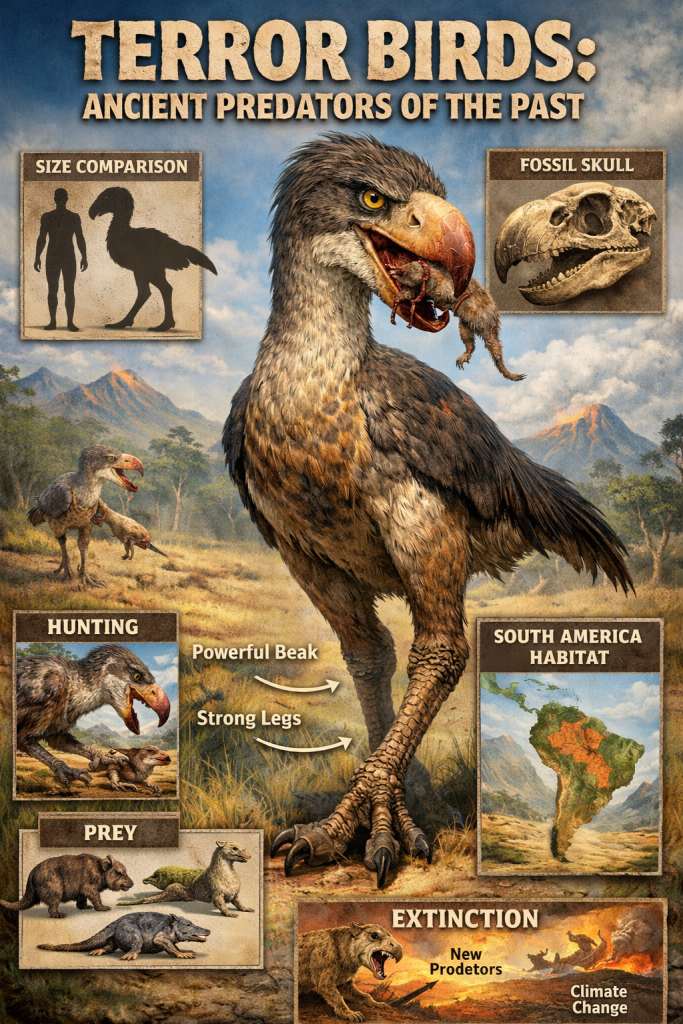
They weren’t your average birds. Picture a creature standing up to 10 feet tall, with powerful legs, a massive skull, and a beak designed for killing. Unlike modern birds that rely on flight or pecking seeds, these animals were apex predators.
In simple terms, they were the top hunters of their time—no wings needed.
A Look Back in Time: When Did They Live?
Terror birds roamed the Earth from about 60 million years ago to roughly 2 million years ago. That’s a long stretch of time—long before humans appeared.
They thrived during the Cenozoic Era, a period when mammals were still evolving and ecosystems were very different from today.
At that time, South America was somewhat isolated, like a giant island. This isolation allowed unique animals—including terror birds—to evolve without competition from large mammalian predators.
Physical Features That Made Them Deadly
Height and Build
These birds could grow as tall as a basketball hoop. Their bodies were built for strength rather than flight. Thick legs and strong muscles made them excellent runners.
The Infamous Beak
The beak was their most terrifying feature. It was large, curved, and razor-sharp—perfect for tearing flesh. Think of it like a built-in weapon, similar to a hooked knife.
Powerful Legs
Instead of wings, their legs were their main tools. They could run at high speeds, chase prey, and deliver crushing kicks.
Small Wings
Their wings were tiny compared to their bodies. They couldn’t fly, but those wings may have helped with balance while running or attacking.
How Did They Hunt Their Prey?
Now, this is where things get really interesting.
Terror birds didn’t just chase their prey—they hunted with strategy. Imagine a mix between a cheetah’s speed and a hawk’s precision.
They likely used a method called strike-and-retreat. They would run toward prey, deliver a powerful peck or blow with their beak, then step back and wait for the prey to weaken.
Some scientists believe they even used their beaks like axes, striking downward with force.
It’s a bit like how a boxer delivers quick, powerful hits and then steps back to avoid counterattacks.
What Did Terror Birds Eat?
Terror birds were carnivores, meaning they ate meat. Their diet likely included:
- Small to medium-sized mammals
- Reptiles
- Other birds
- Possibly carrion (dead animals)
They were opportunistic hunters. If it moved and they could catch it, it was probably on the menu.
Where Did They Live?
Initially, terror birds were found only in South America, where they dominated the food chain.
Later, around 3 million years ago, a land bridge formed between North and South America. This allowed animals to migrate between the continents.
Terror birds made their way north, but their dominance didn’t last long there. They faced new competition from large mammalian predators like saber-toothed cats.
Why Were They So Successful?
You might be wondering—what made these birds so dominant for so long?
Lack of Competition
In their early environment, there weren’t many large predators to compete with them. This gave them a huge advantage.
Adaptability
They could hunt different types of prey and adapt to various environments.
Physical Strength
Their combination of speed, size, and weaponry made them incredibly effective hunters.
In many ways, they were perfectly designed for their ecosystem.
The Decline and Extinction of Terror Birds
Like many ancient creatures, terror birds eventually disappeared. But why?
Arrival of New Predators
When North and South America connected, new predators entered their territory. These included faster, more agile mammals.
Climate Changes
Shifts in climate likely affected their habitats and food sources.
Competition for Food
With more predators around, food became harder to find.
Over time, these factors combined to push terror birds toward extinction.
Fossils: Clues from the Past
Our knowledge of terror birds comes mainly from fossils. These remains have been found in various parts of the Americas.
Fossils help scientists understand:
- Their size and structure
- How they moved
- What they might have eaten
Some fossils even suggest how powerful their bites were.
It’s like solving a giant puzzle—each bone adds another piece to the story.
Comparing Terror Birds to Modern Birds
It might seem hard to connect these terrifying creatures with today’s birds, but there are similarities.
Relatives in the Bird World
Modern birds like seriemas are thought to be distant relatives. While they’re much smaller and less intimidating, they share some physical traits.
Behavioral Similarities
Some modern birds of prey, like eagles, use similar hunting techniques—quick strikes and powerful grips.
But let’s be honest—no bird today comes close to the sheer presence of a terror bird.
Pop Culture and Public Fascination
Terror birds have captured the imagination of people around the world.
They’ve appeared in:
- Documentaries
- Books
- Video games
- Movies
Why are we so fascinated by them?
Maybe it’s because they challenge our idea of what birds are supposed to be. We think of birds as small, fragile, and harmless—but terror birds flip that idea upside down.
They remind us that nature is full of surprises.
What Can We Learn from Terror Birds?
Beyond their fearsome appearance, terror birds teach us important lessons.
Evolution Is Powerful
Life can take many forms, depending on the environment. Terror birds are proof that birds can evolve into top predators.
Change Is Inevitable
Even the most dominant species can disappear. Survival depends on the ability to adapt.
Nature Is Unpredictable
Just when you think you understand how the world works, something like a giant predatory bird comes along.
A Final Thought: Imagining Their World
Close your eyes for a moment.
Picture a vast, open landscape. The wind blows softly, and the ground is alive with movement. Suddenly, a shadow appears. A towering bird steps into view, its eyes locked on its next meal.
Would you run? Or would you freeze?
Terror birds may be gone, but their story still echoes through time—a reminder of a wild, untamed world that once existed.
Conclusion
The terror bird stands as one of the most remarkable predators in Earth’s history. With its towering height, deadly beak, and unmatched hunting skills, it ruled its environment for millions of years. Yet, like all species, it faced challenges it couldn’t overcome.
Its story isn’t just about fear—it’s about evolution, survival, and change. And in a way, it invites us to reflect on our own place in the natural world.
FAQs
1. What made terror birds different from other birds?
Terror birds were large, flightless predators with powerful legs and sharp beaks, unlike most modern birds that fly and eat seeds or insects.
2. Could terror birds fly?
No, terror birds could not fly. Their wings were too small, but they were excellent runners.
3. How fast could a terror bird run?
While exact speeds are unknown, scientists believe they could run very fast—possibly comparable to modern large flightless birds like ostriches.
4. What caused the extinction of terror birds?
Their extinction was likely due to competition with new predators, climate changes, and reduced food availability.
5. Are there any living relatives of terror birds?
Yes, modern birds like seriemas are considered distant relatives, though they are much smaller and not dangerous to humans.